
Reach Subsea (eng)
a company in the field of underwater technology

This information does not constitute investment advice. It is for information purposes only and should not be used as a basis for investment decisions.
Ticker: $Reach.OL
Price: 9,40 NOK
Exchange rate: 1 NOK = 0.087 €
Shares outstanding fully diluted: 316.536.109
Market cap: 260 Mio. €
Enterprise value: 217 Mio €
Valuation 2023
EV/EBITDA: 8.2 EV/FCF: 9.6
EV/Profit: 10.9
Valuation 2024 Forecast
EV/EBITDA: 5.9
EV/FCF: 6.9
EV/Profit: 8.1
Foreword
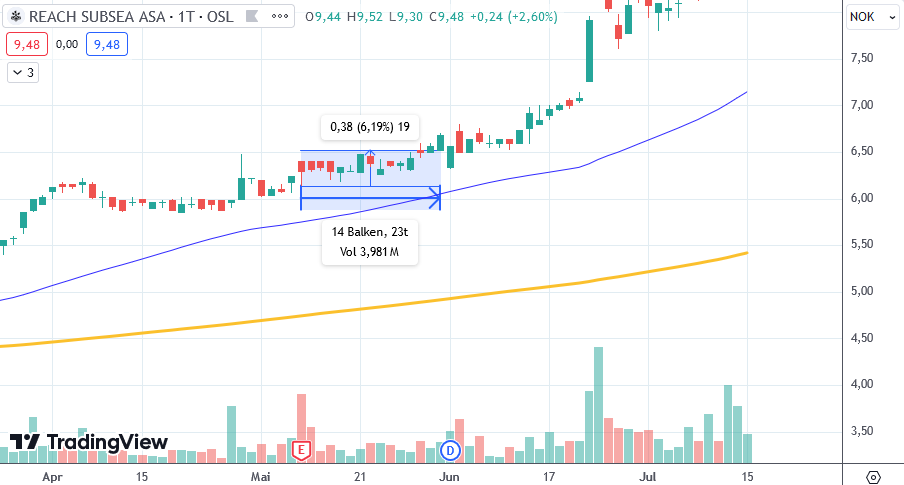
As I sit here writing my first write-up, I have mixed feelings. On one hand, I am incredibly happy about the great development of my investment; on the other hand, the relevance of this write-up is decreasing, as the price has risen by a whopping 44% in the last six weeks since the idea. It is what it is. Please note that all financial figures of the company have been converted from Norwegian Kroner to Euro. Therefore, rounding errors may occur, which I believe are negligible.

Company Description
Reach Subsea is an innovative underwater technology company from Norway, led by its founders. Founded in 2008 and listed on the stock exchange since 2012, Reach Subsea now has office locations worldwide in Norway, Sweden, the United Kingdom, Trinidad, Cyprus, Saudi Arabia, Australia, and Singapore. With a team of 360 employees, the company offers specialized services in the inspection, maintenance, and installation of underwater structures as well as various surveying tasks. Most services are provided with leased vessels that carry their own ROVs (remotely operated vehicles). In addition, Reach Subsea is continuously expanding its capabilities with unmanned vessels (USVs) to meet growing demands and technological advancements.
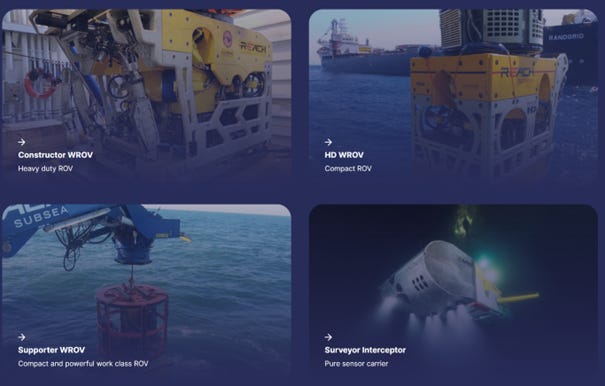
A classic and easy-to-understand example of services provided is the contract awarded by SSEN Transmission (2023). Reach Subsea was commissioned to survey the 165 km long and 500 m wide cable corridor for the HVDC offshore transmission link between Spittal and Peterhead in Scotland.

Why is the company interesting?
In 2020, Kåre Johannes Lie, CEO from 2012 to 2014 and Chairman of the Board until then, stepped down and left the Board in mid-2022. During this time, Anders Onarheim, the largest investor since the company's inception and a Board member, managed to secure a second Board seat with Rachid Bendriss as the new Chairman. From that point on, Reach Subsea decided on an M&A strategy and started an ambitious project, whose investment amount matched the company's market value at the time. Since then, the company has nearly tripled its revenue.
The Reach Remote project involves the development of a remotely operated, state-of-the-art unmanned vessel, with plans to complete two ships by 2022. These ships, along with the associated diving robots (ROVs), aim to offer cost-efficient solutions, especially in the surveying sector. Until then, the company had only worked with leased vessels and had not yet established itself as a leader in surveying technology, as it is today. By now, in 2024, one ship has been completed, and a second one is set to follow this year.
The robotization of the fleet is to be achieved not only through the Reach Remote ships but also with the help of the smaller ROVs of the Drix series from iXBlue. Since April 2023, one such model has been in operation, and a recent announcement revealed that another ship will be put into service soon.
Through strategic acquisitions, the company has acquired the necessary competencies in the areas of surveying, data, and remote operations. This success can certainly be attributed to the addition of Rachid Bendriss in 2020, who brought 18 years of experience in investment banking. He had already been a small shareholder for years and represented the then-largest shareholder, North Energy ASA (32% of shares in 2020).
Reach Remote - an unmanned surface vehicle
The Reach Remote project deserves special mention, even though it has not yet generated any revenue. It is the essence of the company's development since 2020 and offers deep insights into the motivation behind the acquisitions and strategic decisions of the shareholders. The project involves the design of a fully electric, unmanned, and remotely controlled ship, which will also have autonomous capabilities. This unmanned surface vehicle (USV) is primarily intended for surveying and inspection work and will be equipped with a fully electric ROV (Zeerov, a new development from 2023 by Kystedesign). The goal is to reduce costs by 20-30% and emissions by 90-100% compared to conventional ships. The first ship was completed at the end of March 2024, and another is to follow later in the year.


The project was launched in 2021 in collaboration with Kongsberg Maritime and Massterly, a joint venture between Kongsberg and Wilhelmsen, two established companies in the maritime sector. Massterly aims to enable autonomous ship navigation and has recently completed a Remote Operation Center from which Reach Remote can be controlled. In March 2024, the first of two ships was completed, with the second expected to be finished later this year.
For the initial pilot projects, Reach Subsea secured a contract with the energy provider Equinor, with operations set to begin in the fall of 2024. Although the project will not significantly impact revenue in 2024, the company has already secured options for eight more ships, should the pilot be successful and market entry achieved.
The project, encompassing two ships, involves an investment of around 37 million euros. Half of this amount was invested in 2022 and 2023. The necessary financing was secured, among other means, through the issuance of shares, with Wilhelmsen New Energy AS becoming the largest shareholder in 2022 (investment of 13 million euros). The remaining 19 million euros are largely covered through loans, with approximately 16 million euros already secured.
The Acquisitions
March 2021 Acquisition of Surveyor AS
Purchase price: 2 million €
Revenue 2021 (pro forma): 2.5 million €
Net profit (pro forma): -0.5 million €
Main feature: Surveying technology
Surveyor AS was a joint venture between MMT and Reach Subsea, each holding a 50% stake. After MMT was acquired by Ocean Infinity, Reach Subsea was able to acquire the remaining 50% of Surveyor AS.
As part of this joint venture, Kystdesign developed a modern surveying ROV, notable for its high speed compared to other ROVs since its introduction in 2015. With the acquisition of Surveyor AS, Reach Subsea now owns this advanced and powerful ROV.

December 2021 Acquisition of Octio Group
Purchase price: 2.8 million €
Revenue 2021 (pro forma): 3.5 million €
Net profit (pro forma): -1.8 million €
Main features: Surveying technology and Singapore location
With the acquisition of Octio, Reach Subsea significantly expanded its surveying and inspection sector, particularly in data processing. Octio has primarily focused on seabed studies for oil and gas companies, such as monitoring pressure drops. Through this acquisition, Reach Subsea gained valuable expertise in microseismics, which involves monitoring small earthquakes. The associated 4D gravity technology will also be used in the future to monitor CO2 storage sites. Initial pilot projects in this area have already been successfully conducted. Another important aspect of the acquisition is the addition of 30 specially trained employees, who possess extensive skills in data processing. Interestingly, Equinor's venture division was also invested in Octio. Equinor plays a role as a customer in the Reach Remote project.
March 2022 Acquisition of ISurvey Group AS
Purchase price: 12 million € (issuance of 33.8 million shares + 2.1 million € cash)
Revenue 2022 (pro forma): 18.8 million €
Net profit (pro forma): 2.2 million €
Net profit multiple: 5.5
Main features: Surveying, remote, and data processing technology
This acquisition enabled Reach Subsea to integrate the previously missing area of internal data management and expand additional data processing capacities. ISurvey is an asset-light service provider with locations in Norway, the United Kingdom, and Singapore. Additionally, ISurvey brings framework agreements with two cable providers, Nexans and NKT. ISurvey operates across the entire surveying and inspection sector and generated 40% of its 2021 revenue from surveying work for subsea cable routes. This acquisition also significantly strengthens Reach Subsea in remote technology and the associated know-how.
November 2023 Acquisition of Guardian Geomatics
Purchase price: 10.3 million € (issuance of 8.5 million shares + 3.6 million € cash)
Revenue 2022 (pro forma): 15.5 million €
Net profit (pro forma): 1.7 million €
Net profit multiple: 6.1
Main features: Surveying technology and access to Australia
The latest acquisition fits perfectly into Reach Subsea's strategy. Guardian Geomatics is another company in the surveying sector and provides access to the Australian market. Notably, Guardian Geomatics entered into an agreement with Ocius Technology in 2022. This agreement specifies that Guardian Geomatics will integrate its surveying technology into the solar USV developed by Ocius, creating a clear synergy with the Reach Remote project.
Management
The team at Reach Subsea is composed of industry-experienced professionals. Collectively, all C-level employees hold 3.7% of the company’s shares, with CEO Jostein Alendal owning 2.2% of these. Although his share as a co-founder may seem modest, it is due to dilutions over the past 12 years. Jostein Alendal co-founded DeepOcean AS, another marine services company, in 1999. Why he left that company in 2008 to found Reach Subsea remains unclear. However, it is certain that he possesses extensive experience in company founding and the subsea sector.
Below are brief profiles of the C-level employees and their connections to previously mentioned subsea companies.
Jostein Alendal, Chief Executive Officer
He is the founder of Reach Subsea AS and has been the Business Development Manager and CEO of the company since 2008.
Education: Automation Engineer Experience: Technical Manager and co-founder of DeepOcean, with group responsibility for all ROV operations. 31 years in the subsea sector
Shareholding: 2.1% through JT Invest AS, 0.1% as an individual
Birgitte W. Johansen, Chief Financial Officer
She has been the CFO at Reach since 2012. Education: The Blue MBA and Master of Business and Economics
Experience: Account Manager at BNP Paribas, Shipping Department. Analyst and Project Manager at Oceanlink Management. Relationship Manager at SpareBank 1 SR-Bank, Energy and Maritime Department. 25 years in the finance sector
Shareholding: 0.1%
Bård Thuen Høgheim, Chief Commercial Officer
He has been the CCO at Reach since 2014.
Education: Master in Finance from Imperial College Business School Experience: Project Broker in the subsea and renewable market at RS Platou, with experience in offshore industry analysis. 17 years in the subsea sector
Shareholding: 0.3%
Inge Grutle, Chief Operations Officer
She has been the COO at Reach since 2012.
Education: Master of Science in Marine and Subsea Technology Experience: IMR Engineering Manager and Business Development at DeepOcean, with experience in planning and executing offshore and subsea operations. 17 years in the subsea sector
Shareholding: 10,000 shares (~0.005%), INVICTA INVEST with 0.4%
Audun Brandtzæg, Chief Technology Officer
He has been the CTO at Reach since 2023.
Education: Civil Engineer / Surveying Engineer Experience: Offshore / Senior Surveyor, Reporting Manager at Stolt Comex Seaway, Head of Survey at DeepOcean, Asset Manager / Project Manager / Survey Lead at Gassco, Pool Director JV MMT / Reach, Global Operation Director at Ocean Infinity. 34 years in the subsea sector
Shareholding: 0.1%

Board
The Board of Reach Subsea represents a diverse group of shareholders, collectively holding 51% of all shares, with about 8% personally owned by the board members. Of the seven board members, five have extensive experience in the marine sector, while two are well-versed in capital markets.
The longest-serving board member, Anders Onarheim, has been on the board since the company went public in 2012 and represents the then-largest shareholder, North Energy ASA. Rachid Bendriss, who joined as Chairman in 2020, is the CEO of North Energy ASA.
Noteworthy is the appointment of Espen Gjerde as a board member in 2022. Espen Gjerde is the Senior Vice President of Wilhelmsen New Energy AS, a key partner in the Reach Remote project. In 2022, Wilhelmsen New Energy AS became the largest shareholder of Reach Subsea with 46 million shares (21% of Reach Subsea) and options for an additional 45 million shares.
Overall, half of the board members have been in office for four years or less, highlighting the dynamic and refreshed nature of the board.
Finances
As previously mentioned, Reach Subsea has significantly increased its revenues over the past two years, growing annually by about 70%. The management has successfully integrated acquisitions that are both complementary in terms of content and geography. In the first quarter of 2024, Reach Subsea managed to overcome the seasonality of its business for the first time in three years through ongoing geographic expansion. While a 30% decrease in revenue from Q4 to Q1 was typically expected, a revenue growth of 21.3% was achieved, likely supported by the acquisition of an Australian company.
Subsea service companies like TechnipFMC and Subsea 7 also recorded revenue increases of 25% and 12%, respectively, over the past year, indicating a general trend in the industry.
In addition to revenue, EBITDA also saw an increase of 166% from 2021 to 2023. EBITDA margins were 16.7% in 2021, 12% in 2022, and 15.3% in 2023.


The cash flow in 2023 was primarily characterized by investments in the company's fleet and the Reach Remote project. The company has planned a total of 37 million euros for the project, with about half of this amount financed through loans. In 2023, half of the total costs were already capitalized, so a similarly high CapEx is expected for the fiscal year 2024. However, these investments are largely expected to be financed through debt, which means that assuming a constant cash flow burden, the revenue growth should have a direct positive impact on the cash flow.Regarding the balance sheet, it is important to note that all leasing and rental transactions are declared as liabilities. This causes Reach Subsea to appear significantly more indebted in many financial ratios than it actually is. When calculating the enterprise value, the rental obligations were therefore not taken into account.


Regarding the balance sheet, it is important to note that all leasing and rental transactions are declared as liabilities. This causes Reach Subsea to appear significantly more indebted in many financial ratios than it actually is. When calculating the enterprise value, the rental obligations were therefore not taken into account.


Current Valuation
I will divide the company valuation into three timeframes to provide a better assessment. First, the valuation will be based on the fiscal year 2023 figures. Then, this valuation will be updated as TTM (the last four reported quarters). Finally, a valuation for the full year 2024 will be conducted, although only Q1 has been reported and the remaining quarters will need to be modeled based on assumptions. The management generally does not provide specific forecasts.
Forecast Modeling 2024
Basic Assumptions for Margins:
EBITDA Margin: 15%
FCF Margin: 13%
Profit Margin: 11%
These margins are based on the achieved values from the fiscal year 2023. I use these margins as a conservative approach, considering the following points as potential improvements:
Increase in tender volume from 234 million euros in Q1 2023 to 870 million euros
Increased use of remote technology
Reduction of seasonality
Downside Risk Assumption
This assumption is based on reported information. Considering only the statements made, without additional growth or other effects, the annual revenue for 2024 is estimated to be 173.75 million euros:
Reported revenue Q1 2024: 50 million euros
Statement in the call: Q1 backlog is mostly revenue-effective in 2024: 102 million euros
News from 04.06.2024 about extended backlog (assuming 50% of it is revenue-relevant): 21.75 million euros
Modeling According to Screener – Analyst Expectation
The Tradingview screener expects revenue growth of 34%. This seems plausible as Reach Subsea achieved 70% growth in 2022 and 2023, partly due to acquisitions. According to management, 37% of this was organic growth in 2022. One could assume that the 70% growth in 2023 also includes 37% organic growth. Given the timing of acquisitions in 2023, even higher organic growth could be expected. However, for the revenue expectation for 2024, a conservative growth rate of 34% is assumed. Thus, the revenue forecast in this scenario is 233 million euros.
Modeling Based on Backlog
In 2022 and 2023, over 60% of the cumulative annual backlog was converted into revenue, compared to 92% in 2021. Modeling the backlog is generally challenging as it tends to grow but also undergoes significant fluctuations. For this assumption, the backlog achieved in Q1 is extrapolated to the entire year and modeled with a revenue conversion rate of 65%. This results in a projected annual revenue of 293.8 million euros.
Modeling Based on Available Ships
Although this method is one of the less accurate, it raises the question of whether the company can achieve the planned revenues. In Q1, 481 ship days were sold across 8 ships, meaning each ship was "active" for 60 days per quarter. Considering some seasonality, better utilization is expected in the following quarters. For Q2, it is assumed that 8 ships are active for 65 days each, and from Q3 onwards, 10 ships (including Reach Remote and Northern Maria) are active for 65 days each. This results in a total of 2,301 ship days for the year (Q1: 481 ship days, Q2: 520 ship days, Q3: 650 ship days, Q4: 650 ship days). On average, a revenue of 0.1 million euros per ship day is achieved, resulting in a revenue forecast of 230.1 million euros.
Modeling Based on Available Tenders
In Q1 2023, available tenders were at 234 million euros and have now significantly increased to 870 million euros (as of 08.05.2024). In 2023, a backlog of over 270 million euros was generated from the initial 234 million euros in tenders. It is not expected that a higher backlog than the current tender amount can be achieved. In this modeling, it is conservatively assumed that only 50% of the available tenders will flow into the backlog. Furthermore, it is assumed that only 65% of this backlog will be converted into revenue. This results in an annual revenue forecast of 283 million euros.

Forecast Modeling 2024
Basic Assumptions for Margins:
EBITDA Margin: 15%
FCF Margin: 13%
Profit Margin: 11%
These margins are based on the achieved values from the fiscal year 2023. I use these margins as a conservative approach, considering the following points as potential improvements:
Increase in tender volume from 234 million euros in Q1 2023 to 870 million euros
Increased use of remote technology
Reduction of seasonality
Downside Risk Assumption
This assumption is based on reported information. Considering only the statements made, without additional growth or other effects, the annual revenue for 2024 is estimated to be 173.75 million euros:
Reported revenue Q1 2024: 50 million euros
Statement in the call: Q1 backlog is mostly revenue-effective in 2024: 102 million euros
News from 04.06.2024 about extended backlog (assuming 50% of it is revenue-relevant): 21.75 million euros
Modeling According to Screener – Analyst Expectation
The Tradingview screener expects revenue growth of 34%. This seems plausible as Reach Subsea achieved 70% growth in 2022 and 2023, partly due to acquisitions. According to management, 37% of this was organic growth in 2022. One could assume that the 70% growth in 2023 also includes 37% organic growth. Given the timing of acquisitions in 2023, even higher organic growth could be expected. However, for the revenue expectation for 2024, a conservative growth rate of 34% is assumed. Thus, the revenue forecast in this scenario is 233 million euros.
Modeling Based on Backlog
In 2022 and 2023, over 60% of the cumulative annual backlog was converted into revenue, compared to 92% in 2021. Modeling the backlog is generally challenging as it tends to grow but also undergoes significant fluctuations. For this assumption, the backlog achieved in Q1 is extrapolated to the entire year and modeled with a revenue conversion rate of 65%. This results in a projected annual revenue of 293.8 million euros.
Modeling Based on Available Ships
Although this method is one of the less accurate, it raises the question of whether the company can achieve the planned revenues. In Q1, 481 ship days were sold across 8 ships, meaning each ship was "active" for 60 days per quarter. Considering some seasonality, better utilization is expected in the following quarters. For Q2, it is assumed that 8 ships are active for 65 days each, and from Q3 onwards, 10 ships (including Reach Remote and Northern Maria) are active for 65 days each. This results in a total of 2,301 ship days for the year (Q1: 481 ship days, Q2: 520 ship days, Q3: 650 ship days, Q4: 650 ship days). On average, a revenue of 0.1 million euros per ship day is achieved, resulting in a revenue forecast of 230.1 million euros.
Modeling Based on Available Tenders
In Q1 2023, available tenders were at 234 million euros and have now significantly increased to 870 million euros (as of 08.05.2024). In 2023, a backlog of over 270 million euros was generated from the initial 234 million euros in tenders. It is not expected that a higher backlog than the current tender amount can be achieved. In this modeling, it is conservatively assumed that only 50% of the available tenders will flow into the backlog. Furthermore, it is assumed that only 65% of this backlog will be converted into revenue. This results in an annual revenue forecast of 283 million euros.
Summary
The following image shows the results of the different modeling approaches. It can be concluded that, despite the recent price increase, Reach Subsea does not appear to be overvalued.

All revenue models, including the downside modeling, have been consolidated into a combined model. It is worth noting that this combination is based on what I consider to be conservative assumptions and yet slightly exceeds the analyst estimates from Tradingview.

Given the manageable valuation compared to a larger competitor like Subsea 7 (comparison from 15.07.2024: P/E ratio of Subsea 7 at 92 and P/E ratio of Reach Subsea at 11 according to Tradingview), I see significant upside potential here.
Conclusion
What can be done with all this information? On one hand, one might assume that a highly technological, fast-growing company in a niche segment like Reach Subsea will eventually achieve its deserved multiple expansion (e.g., EV/EBITDA of 12), offering an upside of 100%.
On the other hand, one could wait for the next quarterly results to see if the current models might have been too conservative. In the past, there has been ample time to analyze new figures. I assume that investors will also have a few hours, if not days, to evaluate this time.
Therefore, it can be said that this case is particularly well-suited to be kept on standby for now.
If you have any questions, please feel free to contact me in the comments section and thank you for your time :)